
Key Takeaways
- Cloud-delivered SWGs enhance threat protection by blocking web-based threats before users interact with them.
- They deliver uniform security policies across all users and locations.
- Organizations achieve deeper visibility and more effective control over online activities.
- Robust access controls and data protection features support compliance efforts.
- Moving security to the cloud reduces both security incidents and costs.
Table of Contents
As cyber threats become more sophisticated and frequent, organizations are reevaluating their security strategies to keep digital assets safe. Cloud-delivered Secure Web Gateways (SWGs) are a powerful way to protect organizations from advanced web-based attacks, phishing, and unauthorized access. Their cloud-native architecture provides pervasive emergency protection and simplifies ongoing security management. Companies looking to secure their digital environments are increasingly exploring cloud-based offerings, such as a secure web gateway, as a core element of their infrastructure.
These gateways bridge the security gap for remote and hybrid workforces, granting reliable, location-agnostic defense and policy enforcement. Cloud-delivered SWGs can replace or augment legacy hardware, support scalability, and offer a range of advanced security features that are updated in real time. This ensures threat intelligence keeps pace with the latest attack vectors.
By delivering their functions through the cloud, SWGs reduce latency, improve end-user productivity, and provide organizations with a future-proof way to address shifting security and compliance requirements. As digital transformation accelerates and employees work from various locations and devices, cloud-secured gateways align security operations with business agility.
A successful SWG deployment enhances endpoint protection, strictly enforces acceptable use policies, and provides critical oversight of cloud app usage, all while reducing costs and operational complexity. Companies that move security controls to the cloud can respond faster to incidents and consistently secure all endpoints against evolving online threats.
Enhanced Threat Protection
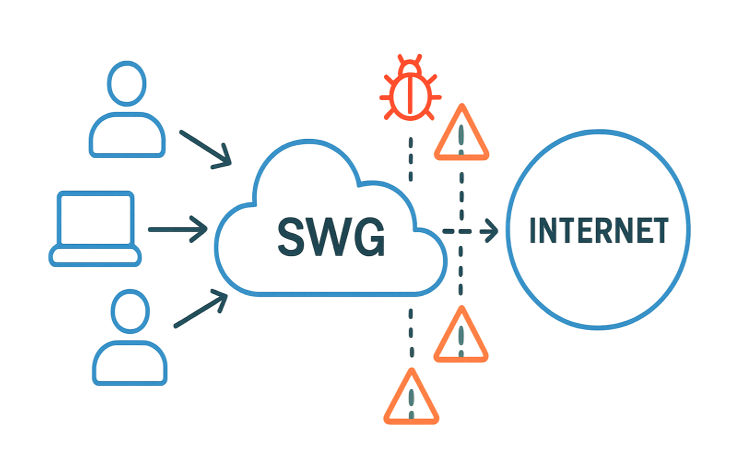
Cloud-delivered SWGs act as a buffer between users and the open web, filtering traffic and analyzing threats before they ever reach a user’s device. By continuously monitoring web interactions, SWGs can detect and block malware, phishing attempts, malicious scripts, and dangerous downloads in real-time. Advanced threat intelligence and sandboxing features bolster detection of new and emerging threats.
Consistent Policy Enforcement
New work patterns have made managing security across different locations more complicated. Cloud-delivered Secure Web Gateways (SWGs) enable IT teams to enforce uniform internet usage policies regardless of whether employees are at headquarters, branch offices, or working remotely. Because these solutions operate from the cloud, they can apply the same security rules and protections to every user connection, ensuring consistent oversight across distributed environments.
Policies around web filtering, access to high-risk or productivity-draining sites, and allowable cloud app usage are centrally managed, reducing the likelihood of policy gaps. Administrators can quickly update rules and push them across the entire network without requiring manual changes at each location. Furthermore, organizations can more easily comply with regulatory mandates such as GDPR, HIPAA, or PCI-DSS by auditing and controlling data flows across their networks.
This centralized visibility helps security teams monitor activity, generate compliance reports, and quickly respond to potential violations or suspicious behavior.
Improved Visibility and Control
Organizations need comprehensive insight into network activity to address risks proactively. SWGs provide real-time logs and rich analytics about web usage, flagged threats, and policy violations. This visibility not only improves the security posture but also helps identify shadow IT and unsanctioned cloud apps in use within the enterprise.
Enhanced visibility helps optimize policies, identify training gaps, and respond to incidents more rapidly. IT and security teams benefit from advanced reporting as they track trends and fine-tune risk management strategies.
Data Loss Prevention
Protecting sensitive business data and personal information is crucial in an era of frequent breaches. Cloud-delivered Secure Web Gateways (SWGs) incorporate Data Loss Prevention (DLP) tools to monitor traffic for sensitive content leaving the network. By analyzing files, emails, and web uploads in real time, these systems can identify confidential information, such as customer records, financial data, or proprietary documents, before it is transmitted outside the organization.
By automatically encrypting, blocking, or alerting on policy violations involving data such as PII or intellectual property, SWGs thwart both accidental leaks and malicious exfiltration attempts. Security teams can also create customized policies that define how different types of data should be handled across applications and user groups.
These controls not only safeguard the organization’s reputation but also help meet requirements set by regulatory frameworks and privacy laws. As a result, businesses gain stronger oversight of sensitive information while maintaining secure, compliant digital operations.
Cost Savings
Shifting security infrastructure to the cloud can yield significant cost efficiencies. By delivering SWG functionality as a service, organizations alleviate the need for expensive hardware deployments and maintenance. Local internet breakouts reduce backhauling of traffic to central data centers, lowering bandwidth consumption and improving application performance for users. Addressing mounting security challenges more economically can free resources for other IT priorities.
Scalability and Flexibility
Cloud-delivered SWGs are built for modern business growth and technological change. As workforce size and network traffic fluctuate, scaling capacity up or down is seamless. Organizations can adapt security capabilities to their evolving needs without the hassle and expense of regular hardware upgrades. Flexible policy configurations ensure organizations remain secure during business expansions, mergers, or rapid growth. Cloud-delivered solutions allow enterprises to innovate while maintaining stringent security controls.
Conclusion
Cloud-delivered Secure Web Gateways are a critical pillar of effective cybersecurity for today’s interconnected businesses. Their ability to deliver enhanced threat prevention, unified policy enforcement, deeper oversight, and data protection, while optimizing costs and supporting growth, makes them an indispensable tool for IT and security leaders.
As enterprise networks become more distributed and attackers more organized, investing in modern, cloud-based security architecture is fundamental to ensuring business continuity and resilience.
 Smith
Smith