
Key Takeaways
- Data-driven decision-making is crucial for achieving greater responsiveness and efficiency in supply chains.
- Adopting advanced technologies such as AI and IoT enhances operational agility and resilience to disruptions.
- Robust data management is necessary for mitigating risks and achieving sustainable success in complex environments.
Table of Contents
Supply chain agility is no longer a luxury but an operational necessity in a marketplace defined by volatility and shifting demands. To gain the flexibility essential to thrive, businesses are turning to data-driven decision-making, leveraging comprehensive insights to drive efficiency, reduce risks, and bolster competitiveness. One practical application of this approach is the use of an advanced pricing system for M&D, which enables organizations to optimize margins and proactively address market changes.
Organizations that harness accurate, real-time data respond faster to disruptions, streamline workflows, and better anticipate future needs. Data-centric strategies empower leaders to pinpoint supply chain bottlenecks, predict customer behavior, and adapt operations at scale.
From forecasting to logistics, the ability to aggregate, analyze, and act on actionable intelligence has transformed how supply chains operate in every sector. By applying robust analytics, companies discover opportunities for continuous improvement, keep inventory aligned with demand, and maintain service levels even amidst significant uncertainties. This strategy is particularly vital as global events and evolving consumer preferences demand greater operational resilience.
Importance of Data-Driven Decision Making
The volume and complexity of supply chain data continue to grow as global trade expands and interconnected networks evolve. Through data-driven decision-making, businesses identify vulnerable links, reduce the risk of disruption, and adapt dynamically. Analytical tools turn raw data into predictive insights, creating real value by improving demand forecasting accuracy, optimizing inventory, and increasing customer satisfaction.
Research from McKinsey underscores the role of advanced analytics in helping companies remain agile, especially amid crises such as the COVID-19 pandemic. This ability to react quickly is what sets best-in-class supply chains apart in times of uncertainty.
Technologies Enhancing Supply Chain Agility
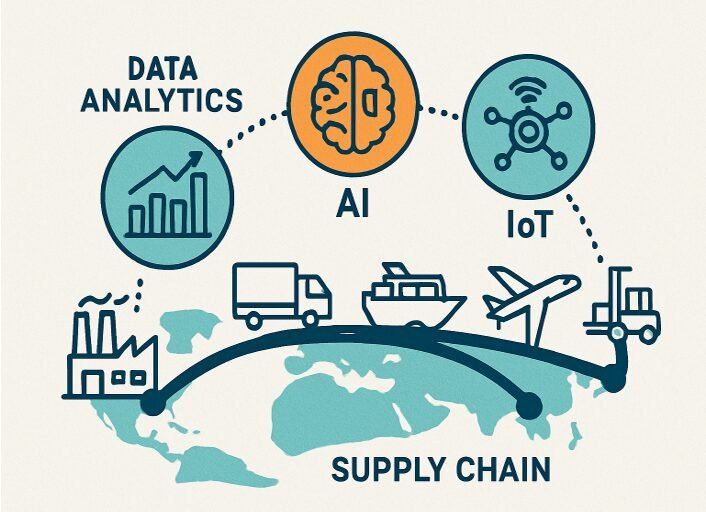
Next-generation technology plays a pivotal role in enhancing supply chain decision-making and agility. Key components include Artificial Intelligence (AI), which drives precision forecasting, predictive demand analytics, inventory optimization, and dynamic pricing. The Internet of Things (IoT) provides real-time monitoring and end-to-end visibility of goods and assets, thereby enhancing accountability and minimizing inefficiencies.
Blockchain technology ensures transparency and security by maintaining an immutable record of transactions and inventory movements, enabling traceability. Additionally, Robotic Process Automation (RPA) automates repetitive tasks, such as data entry, reducing human error and enabling personnel to focus on more strategic challenges, thereby driving overall efficiency in supply chain operations.
Implementing AI for Supply Chain Optimization
Rolling out AI within supply chains typically follows a three-stage process: data collection, data analysis, and decision support. Vast swathes of structured and unstructured data (sales transactions, supply logs, and market signals) are integrated into machine learning models that highlight performance gaps and identify opportunities.
Resulting insights inform adjustments that can dramatically improve inventory accuracy, reduce lead times, and enhance service levels. Use cases such as reinforcement learning-driven warehouse orchestration demonstrate the measurable gains and precision AI can bring to modern supply chains. For further depth, Harvard Business Review explains how leading companies are developing targeted AI solutions in their supply chain ecosystems.
Role of IoT in Supply Chain Management
IoT solutions are revolutionizing supply chain visibility and proactive management. Sensors capture data on location, temperature, humidity, and equipment status, and transmit real-time insights to centralized dashboards. With this data, logistics teams can respond instantly to deviations, address unexpected maintenance needs, and reduce waste stemming from spoilage or delays. The benefits extend across the entire logistics network, increasing resilience and improving overall supply chain performance.
Case Studies of Successful Data Integration
Global organizations are embracing end-to-end data integration as the foundation for transformation. For example, Aboitiz pivoted from a traditional infrastructure to an AI-driven enterprise, achieving significant operational improvements and resilience.
Their strategy centered on eliminating data silos and creating an ecosystem that enables seamless sharing of insights across business units. These leaders demonstrate that the holistic integration of data, technology, and analytics drives continuous improvement, better risk mitigation, and faster decision-making. More about their strategy and success can be found on Gulf News.
Challenges in Adopting Data-Driven Strategies
Enterprises embarking on data-driven supply chain optimization often face persistent challenges. Data silos impede comprehensive analysis, while poor data quality results in flawed models or misguided decisions. A successful transformation requires deliberate change management to overcome resistance, provide employee training, and align culture with new processes. The path to overcoming barriers emphasizes not just tools and platforms but also mindset and governance.
Best Practices for Data Management
- Establish robust data governance policies to ensure quality, consistency, and compliance.
- Invest in advanced data cleansing and integration tools to support reliability and completeness.
- Encourage a culture where data-driven decision-making is the norm at every organizational level.
- Adhere strictly to data privacy regulations to maintain trust and avoid regulatory pitfalls.
These foundational best practices create an environment where supply chain professionals can trust their data and forge actionable, timely strategies.
Future Trends in Supply Chain Data Utilization
The future of supply chain management will be defined by innovations in predictive analytics, digital twins, and collaborative platforms. Predictive analytics will empower organizations to anticipate issues and opportunities with greater precision, enabling more effective resource allocation and risk reduction.
Digital twins, or virtual replicas of supply networks, will facilitate advanced modeling and scenario planning. Enhanced collaboration tools will ensure that decisions are shared transparently among all supply chain stakeholders, enabling faster responses in critical moments.
Remaining adaptive by investing in these trends will ensure that supply chain leaders can not only weather disruptions but also capitalize on emerging opportunities in an ever-evolving environment.
 Smith
Smith